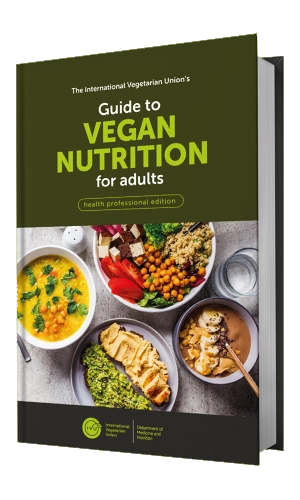
The International Vegetarian Union’s Vegan Nutrition Guide for Adults
Free material, in 2 versions:
1. For healthcare professionals 2. For non-healthcare professionals
Choose your option below
Attention:
The non-technical version is being formatted and should to be ready in a few months. The technical (professional) version is available.
FREE DOWNLOAD the Technical (professional) version
* We don’t share your personal info with anyone.
FREE DOWNLOAD the Non-Technical (lay people) version
* We don’t share your personal info with anyone.

GUIDE INDEXPART 1 - GETTING TO KNOW VEGETARIANISM
1. DEFINITIONS 2. REASONS THAT LEAD TO VEGETARIANISM 3. THREAT TO GLOBAL HEALTH: CONSUMPTION IMPACT OF ANIMAL DERIVED FOODS 3.1. Food choices and sustainability 3.2. A near future 3.3. Pandemic and epidemics 3.4. Antimicrobial resistance 4. VEGETARIANISM IN THE WORLD
PART 2 — HEALTH EFFECTS
1. A VEGETARIAN’S DIET POTENTIAL FOR PREVENTION AND TREATMENT 1.1 Fibers 1.2 Microbiota 1.3 Antioxidants, phytochemicals and phytosterols 1.4 Exclusion of animal products 1.5 Saturated fat 1.6 Advanced glycation and lipo-oxidation products 1.7 Trimethylamine oxide (TMAO) 1.8 Thermal action on meat 1.9 N-glycolil-neuramine (Neu5Gc) acid 1.10 Heme Iron 2. PESTICIDES 3. NON-COMMUNICABLE CHRONIC DISEASES 3.1 Systematic reviews and meta-analyses 3.2 Controlled studies 3.2.1 Diabetes 3.2.2 Cardiovascular diseases 3.2.3 Cancer 3.2.3.1 Prostate 3.2.3.2 Breast 3.2.4 Obesity 3.2.5 Anorexia nervosa
PART 3 — SUPPLEMENTATION
There is no intensive animal rearing without intensive supplementation: omnivores are more supplemented than vegetarians. 1. Protein 2. Vitamin B12 3. Calcium 4. Iodine 5. Omega-3 6. Final considerations PART 4 — NUTRITIONAL ADEQUACY OF THE VEGETARIAN DIET 1. Getting to know food groups 2. Vegetarian food plan
PART 5 — MACRONUTRIENTS
1. Carbohydrates2. Fats 2.1 Omega-3 2.1.1 Chapter Summary 2.1.2 Functions 2.1.3 Conversion of ALA into EPA and DHA and LA into AA 2.1.4 DHA metabolism in the human body 2.1.5 Factors affecting ALA elongation and desaturation 2.1.6 Individuals with genetic changes 2.1.7 Backconversion: DHA turns into EPA, but EPA doesn't turn into DHA 2.1.8 How much and how to use ALA in vegetarian diet 2.1.9 Nutritional status of omega-3 in vegetarians 2.1.10 Should vegetarians and vegans use DHA supplement? 2.1.11 Do only vegetarians need to pay attention to ALA sources? 2.1.12 Food sources 2.1.13 Does supplemental DHA from microalgae work? 2.1.14 Do not use fish oil as a source of EPA and DHA 2.1.15 IVU position on the use of omega-3 in vegetarians/vegans 3 Proteins 3.1 Chapter Summary 3.1 Protein intake in vegetarian populations 3.2 By ingesting enough calories, we usually ingest enough protein 3.3 The quality of protein 3.4 Little commented positive aspects of plant protein 3.5 About soy 3.6 There is no evidence of protein deficiency in vegetarians 3.7 Amino acids in the vegetarian diet 3.7.1 Needs for amino acids 3.7.2 Vegetables contain all amino acids 3.7.3 Adequacy of amino acids in practice 3.8 Swap meats for legumes 3.9 How to adjust protein and amino acids when adopting a vegetarian diet 3.10 IVU position on the use of proteins and amino acids by vegetarians
PART 6 — MICRONUTRIENTS
PART 3 — SUPPLEMENTATION
There is no intensive animal rearing without intensive supplementation: omnivores are more supplemented than vegetarians. 1. Protein 2. Vitamin B12 3. Calcium 4. Iodine 5. Omega-3 6. Final considerations PART 4 — NUTRITIONAL ADEQUACY OF THE VEGETARIAN DIET 1. Getting to know food groups 2. Vegetarian food plan
PART 5 — MACRONUTRIENTS
1. Carbohydrates2. Fats 2.1 Omega-3 2.1.1 Chapter Summary 2.1.2 Functions 2.1.3 Conversion of ALA into EPA and DHA and LA into AA 2.1.4 DHA metabolism in the human body 2.1.5 Factors affecting ALA elongation and desaturation 2.1.6 Individuals with genetic changes 2.1.7 Backconversion: DHA turns into EPA, but EPA doesn't turn into DHA 2.1.8 How much and how to use ALA in vegetarian diet 2.1.9 Nutritional status of omega-3 in vegetarians 2.1.10 Should vegetarians and vegans use DHA supplement? 2.1.11 Do only vegetarians need to pay attention to ALA sources? 2.1.12 Food sources 2.1.13 Does supplemental DHA from microalgae work? 2.1.14 Do not use fish oil as a source of EPA and DHA 2.1.15 IVU position on the use of omega-3 in vegetarians/vegans 3 Proteins 3.1 Chapter Summary 3.1 Protein intake in vegetarian populations 3.2 By ingesting enough calories, we usually ingest enough protein 3.3 The quality of protein 3.4 Little commented positive aspects of plant protein 3.5 About soy 3.6 There is no evidence of protein deficiency in vegetarians 3.7 Amino acids in the vegetarian diet 3.7.1 Needs for amino acids 3.7.2 Vegetables contain all amino acids 3.7.3 Adequacy of amino acids in practice 3.8 Swap meats for legumes 3.9 How to adjust protein and amino acids when adopting a vegetarian diet 3.10 IVU position on the use of proteins and amino acids by vegetarians
PART 6 — MICRONUTRIENTS
1. Vitamin B12 1.1. Chapter Summary 1.2. About Vitamin B12 1.3. Physiology: absorption and transport of B12 1.4. Metabolic actions 1.5. B12 deficiency 1.6. Diagnosis of B12 deficiency 1.7. Adequate vitamin B12 levels 1.8. Statistics on vitamin B12 deficiency 1.9. Recommendation for vitamin B12 intake 1.10. Dietary sources of vitamin B12 1.11. Food factors that interfere with vitamin B12 1.12. Treatment of deficiency 1.12.1. Types of B12 1.12.2. Oral or intramuscular 1.12.3. Oral or sublingual 1.12.4. Toothpaste 1.12.5. Fasting or with food? 1.12.6. Use for how long? 1.13. Expected response to treatment 1.14. Toxicity, side effects and misinterpretations about B12 1.15. Maintaining the good levels achieved 1.16. Deficiency prevention 1.17. When should I start supplementing when becoming vegetarian? 1.18. IVU Position on Vitamin B12 in Vegetarian Diets 2. Vitamin D 2.1. Chapter Summary 2.2. Vitamin D metabolism 2.3. Ingestion recommendations 2.4. Assessment of vitamin D nutritional status 2.5. Food sources of vitamin D 2.6. Vitamin D enrichment and "alternative" foods 2.7. Treatment 2.8. Toxicity 2.9. Studies on vitamin D deficiency in vegetarian groups 2.10. IVU position on vitamin D in vegetarian diets 3. Calcium 3.1. Chapter Summary 3.2. Calcium metabolism 3.3. Recommendation for calcium intake 3.4. How is calcium intake in vegetarian groups? 3.5. Determinants of bone mass 3.6. Bone mass of vegetarian groups 3.7. Antinutritional factors 3.8. Food sources 3.8.1. Enriched foods 3.8.2. Calcium-rich water 3.8.3. Tofu 3.8.4. Bioavailability 3.8.5. Foods richer in calcium 3.9. Calcium supplementation 3.10. IVU position on calcium in vegetarian diets 4. Iron 4.1. Chapter Summary 4.2. Understanding the importance of iron 4.3. Metabolic functions 4.4. Absorption 4.5. Heme iron 4.6. Transportation and storage 4.7. Iron recycling 4.8. Regulation of systemic homeostasis 4.9. Iron deficiency anemia 4.10. Iron deficiency 4.11. Diagnosis of iron deficiency 4.12. Iron nutritional status in vegetarians 4.13. Need for iron intake by vegetarians 4.14. Iron intake by vegetarian populations 4.15. Optimizing iron food sources 4.16. Meat consumption does not meet iron needs 4.17. Iron deficiency is treated with supplement 4.18. IVU position on iron in vegetarian diets
PART 6 — MICRONUTRIENTS
5. Zinc 5.1. Chapter Summary 5.2. Zinc functions 5.3. Kinetics and body distribution 5.4. Absorption 5.5. Ingestion recommendation 5.6. Determination of zinc nutritional status 5.7. Adaptations in case of low zinc intake 5.8. Population studies in vegetarians 5.9. Zinc content in food 5.10. IVU position on zinc in vegetarian diets 6. Iodine 6.1. Chapter Summary 6.2. From the history of iodine to salt enrichment 6.3. Recommended intake 6.4. Iodine functions in the human body 6.5. Iodine excess 6.6. Iodine metabolism 6.6.1. Thyroid hormone production 6.6.2. Metabolic response to low iodine intake 6.7. Foods and nutrients that theoretically can affect thyroid hormone production 6.8. Iodine sources 6.9. Vegetarian feeding and iodine deficiency 6.10. IVU position on iodine in vegetarian diets
PART 7 — ANTINUTRITIONAL FACTORS 1. Chapter Summary 2. Antinutrients: beneficial actions and nutritional care 3. Lectins 4. Oxalates 5. Bociogenic substances 6. Phytoestrogens 7. Phytates 8. Tannins 9. IVU position on antinutritional factors
PART 8 - BIBLIOGRAPHY
PART 9 — CALCULATED GLOBAL MENUS 1. African 2. Brazilian 3. Chinese 4. European 5. Indian 6. North American

100% Free Material
You may share this copy and use any part of the document as long as it is not removed from the original context and the source is cited.
Detailed information
The Guide presents in depth information of all biochemistry and physiology related to nutrients and is directed towards diagnosis and treatment.

The most complete Vegan Guide ever made available
It comprises more than 500 pages, over 700 scientific references and 30 days of recipes from various countries calculated..
This material will be available soon.
Register to receive as soon as it’s ready.

Download for free
We HATE spam. Your email address is 100% secure